
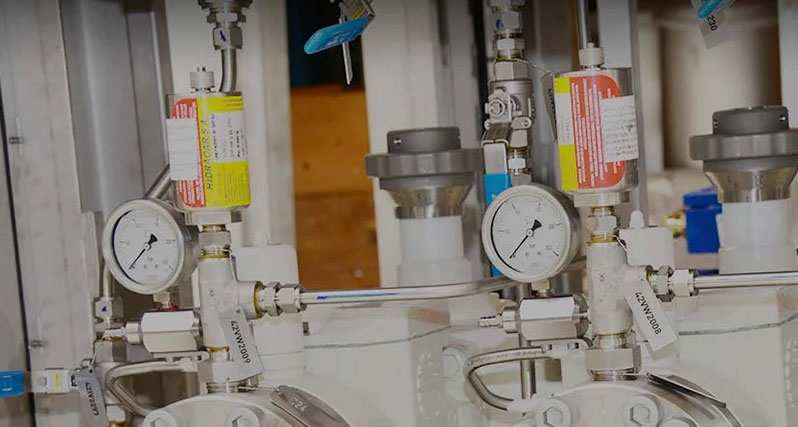
In industrial hydraulic systems, stability and flow control are key factors in ensuring efficient, safe, and long-lasting operation. However, when positive displacement pumps—such as piston or diaphragm pumps—are used, periodic variations in fluid pressure known as pulsations are generated. These oscillations can seriously affect system performance if not properly controlled. This is where a fundamental component comes into play: the pulsation dampener.
In this article, we explain in detail what a pulsation dampener is, how it works, and why it is an essential component in numerous hydraulic and industrial process systems.
What is a pulsation dampener?
A pulsation dampener is a device designed to reduce pressure fluctuations produced by positive displacement pumps in hydraulic or fluid systems. Due to their operating principle, these pumps do not generate a completely uniform continuous flow; instead, they move fluid in cycles, creating variations in pressure and flow rate.
The dampener acts as a stabilizing element that absorbs pressure peaks and compensates for pressure drops, thereby producing a much more uniform and controlled flow.
In simple terms, it can be compared to a “lung” within the hydraulic system: it absorbs energy when pressure increases and releases it when pressure decreases, smoothing the overall behavior of the circuit.
How does a pulsation dampener work?
The operation of a pulsation dampener is based on a simple yet highly effective principle. It generally consists of a pressure-resistant metal housing and an internal diaphragm, bladder, or piston that separates the fluid from a pre-charged gas volume (typically nitrogen).
The process works as follows:
-
When the pump generates a pressure spike, part of the fluid enters the dampener.
-
The internal gas compresses due to the increase in pressure.
-
When the line pressure decreases, the gas expands and pushes the fluid back into the system.
This continuous compression and expansion cycle significantly reduces pressure variations, resulting in a more consistent flow.
It is important to note that proper gas pre-charge is essential for correct operation. Incorrect configuration can reduce effectiveness or even damage the system.

Why is it important to reduce pulsations?
Uncontrolled pulsations can create multiple problems in an industrial installation. The most common include:
-
Excessive vibrations in pipes and components
-
Annoying noise and water hammer effects
-
Premature wear of valves, seals, and fittings
-
Inaccurate readings in measurement instruments
-
Failures in processes requiring precise dosing
Installing a pulsation dampener improves system stability, extends component lifespan, and reduces maintenance costs.
In applications requiring precise dosing—such as in the chemical, pharmaceutical, or food industries—reducing pulsations is critical to ensuring process quality.
Most common applications
Pulsation dampeners are used in a wide variety of industrial sectors. Their most common applications include:
-
Pumping systems with piston or diaphragm pumps
-
Chemical dosing equipment
-
Water treatment plants
-
High-pressure industrial processes
-
High-pressure cleaning installations
-
Petrochemical and energy industries
In all these environments, pressure stability is essential to guarantee safety, precision, and operational efficiency.
Main benefits of a pulsation dampener
Installing a properly sized pulsation dampener offers multiple advantages:
1. System Protection
By absorbing pressure peaks, the dampener protects pumps, valves, piping, and instruments from unnecessary mechanical stress. This reduces breakdowns and extends equipment lifespan.
2. Greater Dosing Accuracy
In processes requiring fluid injection or dosing, eliminating pulsations results in a much more uniform flow rate. Stable pressure translates into more accurate and repeatable dosing.
3. Reduced Noise and Vibrations
Pressure oscillations generate vibrations that can affect the installation structure. The dampener minimizes these effects, improving the work environment and safety.
4. Maintenance Savings
By reducing component wear, technical interventions and downtime are minimized. Fewer breakdowns mean lower long-term operating costs.

How is it different from a hydraulic accumulator?
Although they may appear similar, a pulsation dampener and a hydraulic accumulator do not perform exactly the same function.
A hydraulic accumulator is primarily designed to store hydraulic energy and release it when the system requires it. In contrast, a pulsation dampener is specifically optimized to smooth rapid and repetitive pressure variations generated by the pump.
While both devices may have a similar construction (a housing with gas and a diaphragm), their design, sizing, and application differ.
Importance of proper sizing
For a pulsation dampener to function effectively, proper sizing is essential. This involves considering factors such as:
-
Pump flow rate
-
Operating pressure
-
Fluid type
-
Temperature
-
Pulsation frequency
-
Installation configuration
An improperly sized dampener can be inefficient or even harmful to the system. Therefore, specialized technical guidance is key to achieving optimal performance.
The pulsation dampener is an essential component in hydraulic systems operating with positive displacement pumps. Its main function is to reduce pressure fluctuations, stabilize flow, and protect the installation from unnecessary vibrations and mechanical stress.
Thanks to its ability to absorb pressure spikes and smooth system behavior, it enhances precision, safety, and durability in industrial equipment.
In environments where efficiency and reliability are priorities, installing a pulsation dampener is not a luxury—it is a technical necessity.
At Hidracar, we have extensive experience in hydraulic solutions tailored to each application. If you need advice selecting the right dampener for your installation, our technical team is ready to help you optimize your system’s performance and safety.
RELATED NEWS

Hidracar
Dear Customer, During the last years, the use of BIM models and 3D models for process plants has increased. HIDRACAR has been…
Read More
Hidracar
Esteemed clients and colleagues, HIDRACAR wants to inform you that we have developed new in-line pulsation dampeners for peristaltic pumps and suction…
Read More
Hidracar
Dear Customer, We are pleased and proud to inform you that we are celebrating our 50th Anniversary during this 2024.…
Read More