
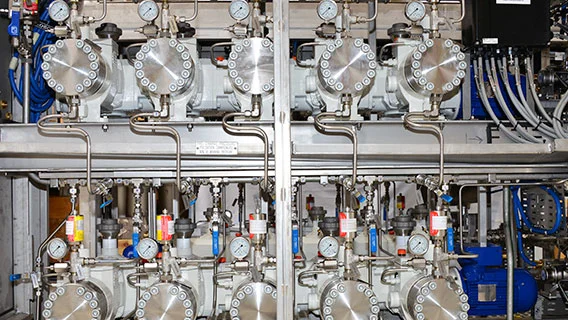
In hydraulic systems, one of the most decisive—and often underestimated—factors is the effect of pressure pulsations. These periodic variations, which may seem insignificant at first glance, have a direct impact on performance, efficiency, and, above all, the durability of key system components. Understanding how pulsations affect pumps and valves is essential to prevent premature failures and optimize maintenance.
What are pulsations and why do they occur?
Pulsations are rapid fluctuations in pressure and flow that are mainly generated by the cyclic operation of pumps, especially positive displacement pumps. These oscillations are transmitted throughout the entire hydraulic circuit, affecting valves, piping, and other elements. Although systems are designed to withstand certain variations, continuous exposure to pulsations can lead to progressive wear and fatigue.

Effects of pulsations on pumps
One of the main issues caused by pulsations is mechanical fatigue. Pumps and valves are subjected to repeated stresses that, over time, can cause microcracks in metal materials and degradation of internal components such as seals and gaskets. This phenomenon significantly reduces equipment lifespan, increasing the risk of unexpected failures.
In addition, pulsations can cause vibrations in the system. These vibrations not only affect the directly involved components but can also be transmitted to nearby structures, generating noise, loosening connections, and causing misalignment. A hydraulic system with constant vibrations is more prone to structural failures and efficiency losses.
Another critical aspect is the impact on seals. Pump gaskets and packing are designed to operate within specific pressure ranges. Constant pulsations can lead to deformation or accelerated wear, resulting in leaks. Leaks not only mean fluid loss but also pose safety risks and increase maintenance costs.
Effects of pulsations on valves
In the case of valves, pulsations can disrupt normal operation. For example, in control valves, pressure fluctuations may cause unwanted or unstable opening and closing. This results in less precise control of flow and pressure, affecting overall system performance. Likewise, in check valves, pulsations can generate water hammer, further increasing mechanical stress.

Effects of pulsations on sensors and instrumentation
- Loss of accuracy and erratic readings: Pulsations create constant pressure peaks and valleys. This causes gauge needles to oscillate violently, making accurate visual readings impossible. In electronic sensors, signal noise can produce unstable values.
- Premature mechanical wear: In analog instruments (such as Bourdon tube pressure gauges), rapid cyclic motion quickly wears out gears and internal mechanisms. In digital sensors, material fatigue in sensing diaphragms can lead to rupture.
- Measurement errors in flow meters: Flow meters (especially ultrasonic or turbine types) are highly sensitive to pulsating flow. If the sensor’s sampling rate is not at least twice the pulsation frequency, an “aliasing” phenomenon occurs, causing significant errors in accumulated flow calculations.
- Frequent recalibration: The repeated impact of pressure waves shifts sensor reference points, requiring more frequent calibration to maintain reliable results.
- False alarms and system trips: Extreme fluctuations may reach the safety thresholds of pressure switches, causing unexpected shutdowns or false alarm activations.

Economic and operational consequences
Operationally, these issues lead to unplanned downtime, reduced productivity, and higher costs for repair or replacement of equipment. Ignoring pulsations can ultimately have a significant economic impact on any hydraulic installation.
To mitigate these effects, it is essential to implement appropriate solutions from the system design stage. One of the most effective strategies is the installation of pulsation dampeners. These devices absorb pressure variations, smooth the flow, and reduce the impact on components. Incorporating them can significantly extend the service life of pumps and valves.
It is also important to properly select materials and pump types based on the application. Some pumps generate fewer pulsations than others, so choosing the right technology can make a substantial difference. Proper equipment selection from the outset reduces the need for corrective interventions in the long term.
Preventive maintenance plays a key role in managing pulsations. Periodic inspections, vibration analysis, and pressure monitoring help detect anomalies before they become major problems. A well-structured maintenance program is the best defense against the negative effects of pulsations.
Finally, training technical personnel is essential. Understanding how pulsations are generated and how they affect the system enables better decision-making in daily operations. Proper training contributes to safer, more efficient, and longer-lasting hydraulic system performance.
In conclusion, pulsations should not be ignored in the design and operation of hydraulic systems. Their cumulative effect can seriously compromise the integrity of pumps and valves. Identifying, controlling, and mitigating pulsations is key to maximizing equipment lifespan and ensuring optimal system performance.
RELATED NEWS
In the food industry, where precision, hygiene, and operational continuity are essential factors, every component within a pumping system plays…
Read More