
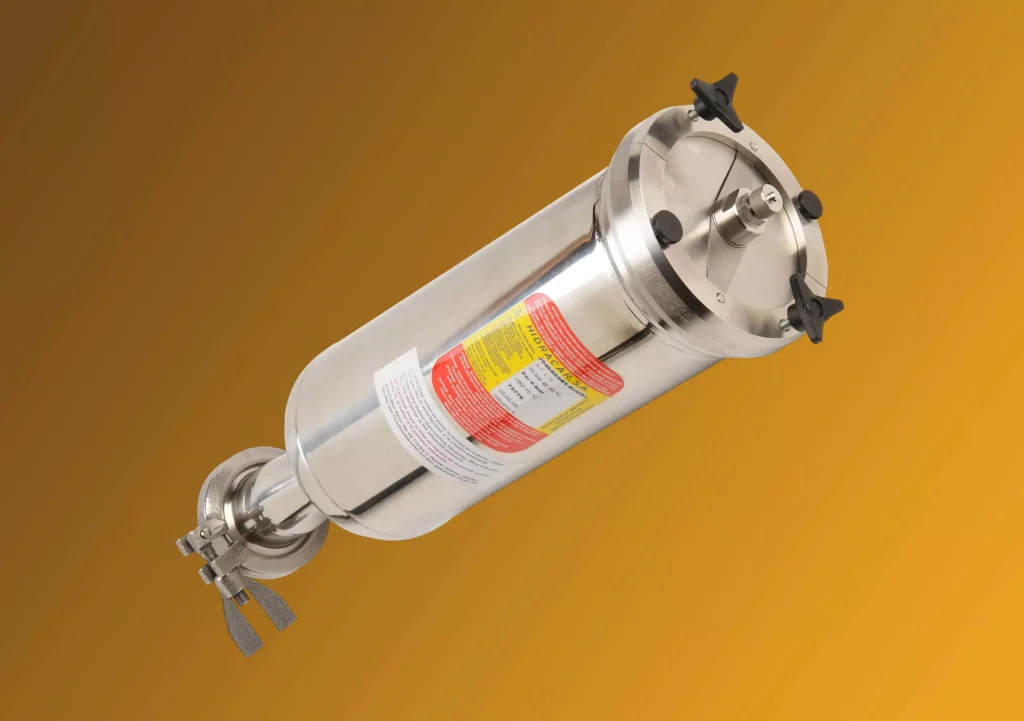
In the food industry, where precision, hygiene, and operational continuity are essential factors, every component within a pumping system plays a critical role. From the transfer of viscous liquids to the precise dosing of ingredients, equipment must deliver consistent and reliable performance. In this context, pulsation dampeners have become fundamental elements for ensuring more stable, safe, and efficient processes.
At Hidracar, specialists in hydraulic solutions and fluid control systems, we have first-hand knowledge of the challenges faced by the food industry. The need to maintain product quality, protect machinery, and optimize operating costs makes it essential to incorporate technologies capable of improving the performance of pumping systems. Among these, pulsation dampeners stand out as particularly important.
What are pulsation dampeners?
Pulsation dampeners are devices designed to absorb and compensate for pressure fluctuations generated by certain types of pumps, especially piston, diaphragm, or membrane pumps. While these pumps are highly efficient for a wide range of industrial applications, they generate a pulsating flow rather than a continuous one.
These pressure fluctuations can cause vibrations, water hammer effects, premature wear of components, and even affect the final quality of food products.
A pulsation dampener acts as a compensation chamber that absorbs pressure peaks and releases energy when the system requires it, thereby achieving a much more uniform flow.
The importance of stable flow in the food industry
In food processing operations, flow consistency is not merely a technical matter; it directly impacts product quality, safety, and production profitability.
Consider applications such as:
- Dosing of sauces and condiments
- Transfer of dairy products
- Processing of juices and beverages
- Pumping of chocolate, creams, and viscous products
- Industrial CIP cleaning systems
- Transfer of oils and syrups
In all these processes, unexpected pressure variations can alter dosing accuracy, generate raw material waste, or compromise the uniformity of the final product.
The integration of pulsation dampeners eliminates these issues and ensures far more precise production.
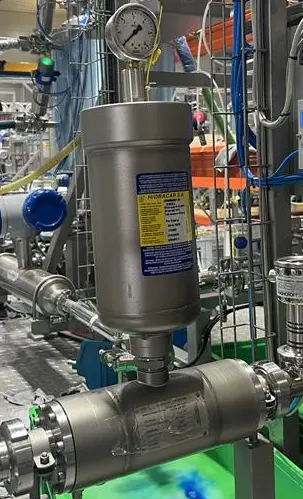
Benefits of pulsation dampeners in food applications
-
Greater dosing accuracy
In many production lines, the precise dosing of ingredients is critical to maintaining product quality and consistency.
An irregular flow can lead to mixing errors, flavor variations, or inconsistencies in the texture of the final product.
Thanks to pulsation dampeners, flow rates become more stable, allowing measurement and control systems to operate with greater accuracy.
-
Protection of pumps and piping
Constant pulsations create repetitive mechanical stress on pipes, valves, sensors, and connections.
Over time, this can result in:
- Leaks
- Loosened connections
- Seal failures
- Accelerated valve wear
- Damage to sensitive instrumentation
Installing a pulsation dampener significantly reduces these mechanical stresses, extending the service life of the entire system.
-
Reduced vibrations and noise
One of the most visible effects of pulsations is the appearance of vibrations throughout production lines. Besides being disruptive, they can affect the structural stability of the system.
Reducing vibrations not only improves operating comfort but also minimizes the risk of breakdowns and unplanned downtime.
In food processing environments where production continuity is critical, this factor becomes strategically important.
-
Improved product quality
For sensitive products such as emulsions, dairy products, beverages, or viscous mixtures, unstable pressure can alter the physical properties of the product.
Hydraulic stability directly contributes to preserving the texture, viscosity, homogeneity, and organoleptic quality of food products.
This results in a more uniform product and a more consistent experience for the end consumer.
-
Energy optimization
When a system operates with fewer vibrations, lower pressure losses, and greater stability, energy performance improves.
A balanced hydraulic system requires less effort to maintain production levels, resulting in reduced energy consumption and lower operating costs.
In a context where sustainability is becoming increasingly important, this benefit is particularly valuable.
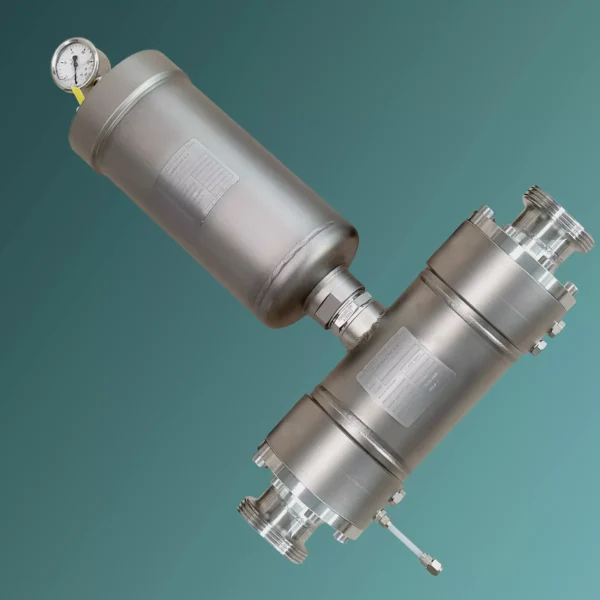
Specific requirements in the food industry
The food industry has very specific requirements regarding materials, cleaning, and regulatory compliance.
Pulsation dampeners used in this sector must meet requirements such as:
- Materials suitable for food contact applications. Hidracar provides materials with FDA certification. In addition, Hidracar has conducted migration testing on vulcanized rubber compounds and can issue a Declaration of Conformity in accordance with European Regulation EC 1935/2004.
- Internal surface finish polished to less than 0.8 microns
- Hygienic designs that are easy to clean
- Compatibility with CIP and SIP cleaning and sterilization processes
- Chemical resistance to detergents and cleaning agents
- Elimination of dead zones that could hinder cleaning
Selecting the right pulsation dampener not only improves system performance but also ensures compliance with the hygiene standards required by the industry.
For this reason, expert technical advice is essential.
The value of a customized solution
Not all food processing operations operate under the same pressure, temperature, viscosity, or flow conditions. Therefore, the selection of a pulsation dampener should always be tailored to the specific application.
Factors such as:
- Type of installed pump
- Operating pressure
- Pulsation frequency
- Nature of the fluid
- Process temperature
- Applicable regulations
- Cleaning systems employed
All directly influence the selection of the most suitable equipment.
An incorrect choice can limit system performance or even create additional problems.
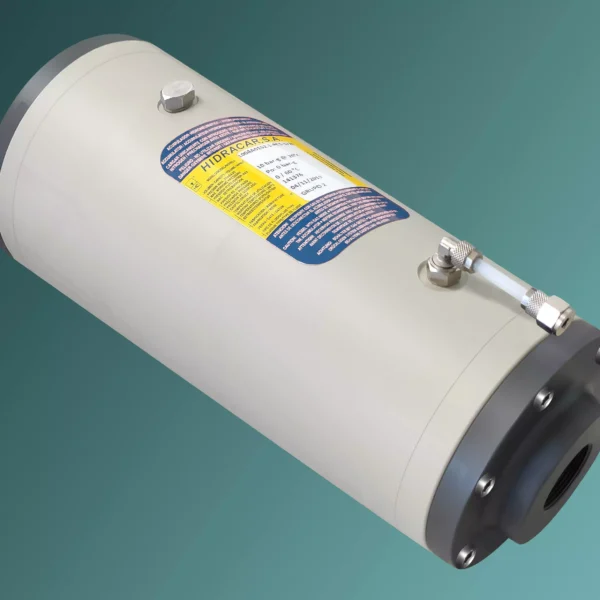
Hidracar: Experience and solutions for the food industry
At Hidracar, we work to provide technical solutions tailored to the real needs of each customer. Our expertise in hydraulic systems and fluid control allows us to design and implement solutions that optimize the efficiency, safety, and reliability of industrial processes.
Pulsation dampeners represent a strategic investment for any food processing facility seeking to maximize productivity, reduce incidents, and guarantee the highest product quality.
From small dosing lines to large-scale continuous processing plants, Hidracar provides its customers with the technical expertise and technology required to meet the challenges of today’s industry.
Investing in hydraulic stability means investing in productivity, durability, and operational excellence.
RELATED NEWS
In hydraulic systems, one of the most decisive—and often underestimated—factors is the effect of pressure pulsations. These periodic variations, which…
Read More