
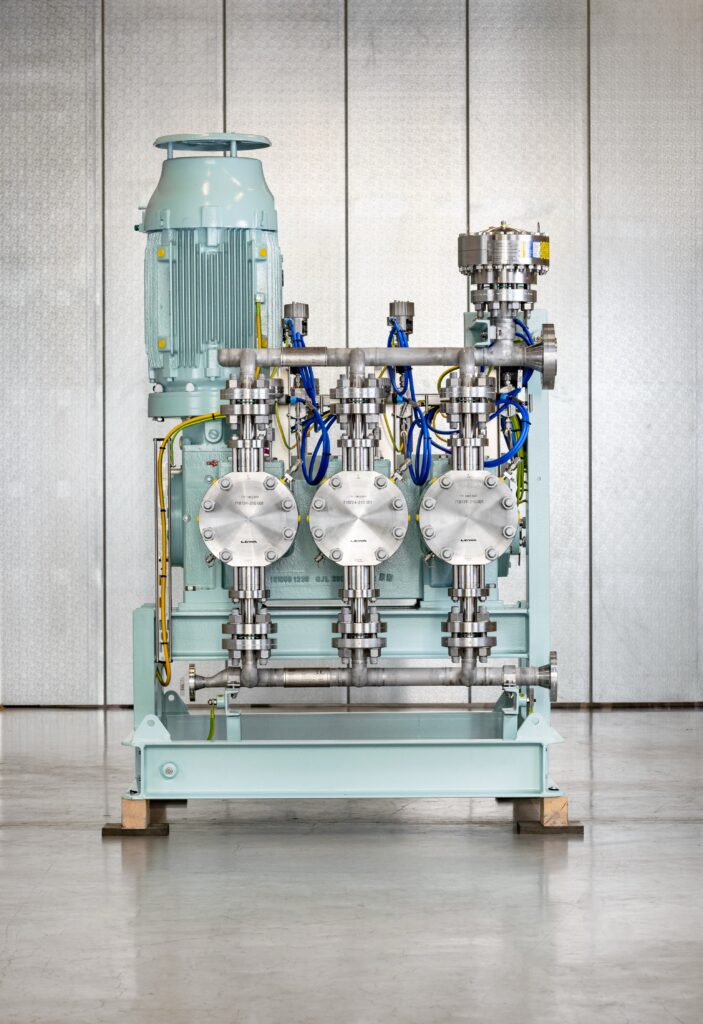
In the chemical industry, fluid transfer and dosing are critical processes. Reagents, acids, solvents, polymers and suspensions must be transported accurately and continuously. However, many of the pumps used for these applications, such as diaphragm, piston and plunger pumps, generate an intermittent flow that causes pressure pulsations throughout the entire system. Pulsation dampeners are the most effective solution for controlling this phenomenon.
What Are Pressure Pulsations and Why Are They a Problem?
Positive displacement reciprocating pumps move fluid in cycles: suction, compression and discharge. This generates pressure and flow rate peaks and drops during each pump cycle, which are transmitted through the pipework in the form of vibrations and water hammer effects.
In the short term, these pulsations may seem like a minor nuisance. However, their medium- and long-term consequences can be serious:
- Premature wear of seals, valves, diaphragms and bearings.
- Fatigue in pipes, supports and connections, increasing the risk of leaks or ruptures.
- Inaccurate readings from flow meters, pressure gauges and other measuring instruments.
- Imprecise dosing, affecting the quality of the final product.
- Noise and vibrations that worsen working conditions within the plant.
In an environment where corrosive, toxic or flammable substances are handled, a leak caused by pipework fatigue poses a risk that no company can afford to take.

How Does a Pulsation Dampener Work?
The operating principle is simple and highly effective. The dampener is installed in the pipeline, as close to the pump as possible, and contains a chamber with compressed gas (usually nitrogen or air), separated from the fluid by a diaphragm, bellows or bladder.
When the pump generates a pressure peak, the excess fluid enters the dampener and compresses the gas. When the pressure drops, the gas expands and pushes the fluid back into the pipeline. In this way, the device absorbs pressure peaks and compensates for pressure drops, converting a pulsating flow into an almost constant flow.
Benefits in the Chemical Industry
Greater Dosing Accuracy
In processes such as neutralisation, water treatment, product synthesis and mixture formulation, the exact proportion of each component is crucial. A stable flow rate ensures that dosing is more accurate and repeatable, resulting in more homogeneous products and less waste of raw materials.
Equipment and System Protection
By reducing overpressure and vibrations, the service life of pumps, pipes, valves and fittings is significantly extended. This reduces unplanned downtime and maintenance costs, which is particularly important in plants operating continuously.
Improved Safety
A pipeline subjected to less mechanical stress is a more reliable pipeline. Reducing the risk of hazardous product leaks protects people, the environment and the installation itself, while also helping companies comply with health, safety and environmental regulations.
More Reliable Measurements
Monitoring instruments perform better under stable flow conditions. With a pulsation dampener, flow meters and sensors provide more accurate readings, improving process control and facilitating automation.
Criteria for Selecting the Right Pulsation Dampener
Not all pulsation dampeners are suitable for every application. In the chemical industry, the following factors should be carefully considered:
- Chemical compatibility of materials. The housing and diaphragm must withstand the fluid being handled. Depending on the application, suitable materials may include stainless steel, PVC, polypropylene, PVDF or PTFE.
- Operating pressure and temperature. The equipment must be sized to withstand the actual operating conditions of the installation.
- Pump type and flow rate. The required dampener volume depends on the pump displacement and the desired degree of pulsation attenuation.
- Gas pre-charge pressure. Correct pre-charge pressure, typically around 80–90% of the operating pressure, is essential for proper performance.
- Installation location. The closer the dampener is to the pump, the more effective it will be.

Installation and Maintenance
Even a correctly sized pulsation dampener can lose much of its effectiveness if it is improperly installed or maintained. It is advisable to check the gas pre-charge pressure regularly, as gas may be lost over time, and inspect the condition of the diaphragm. In applications involving aggressive or abrasive fluids, these inspections should be carried out more frequently.
Simple preventive maintenance helps avoid more serious problems and ensures that the equipment continues to perform as effectively as it did when first installed.
An Investment That Pays for Itself
Compared with the cost of repairing pipework, replacing damaged components or stopping production, a pulsation dampener is a relatively small investment that delivers a very quick return. Its contribution to process stability, safety and equipment longevity makes it an almost essential component in any chemical installation using reciprocating pumps.
Pressure pulsations are a common problem, but one that can be effectively controlled. Choosing the right pulsation dampener, installing it correctly and carrying out regular maintenance makes the difference between an efficient installation and one that is constantly experiencing breakdowns.
At Hidracar, we can help you assess your application and select the solution best suited to your fluids, operating pressures and process requirements. Contact our technical team to find out how you can improve the reliability of your installation.
RELATED NEWS
In hydraulic systems, one of the most decisive—and often underestimated—factors is the effect of pressure pulsations. These periodic variations, which…
Read More
In hydraulic systems and fluid transport installations, maintaining stable pressure is essential to ensure efficient, safe, and long-lasting operation. However,…
Read More
In the food industry, where precision, hygiene, and operational continuity are essential factors, every component within a pumping system plays…
Read More